Barcelona
Why Isn't the Gothic Quarter as Gothic as It Looks?
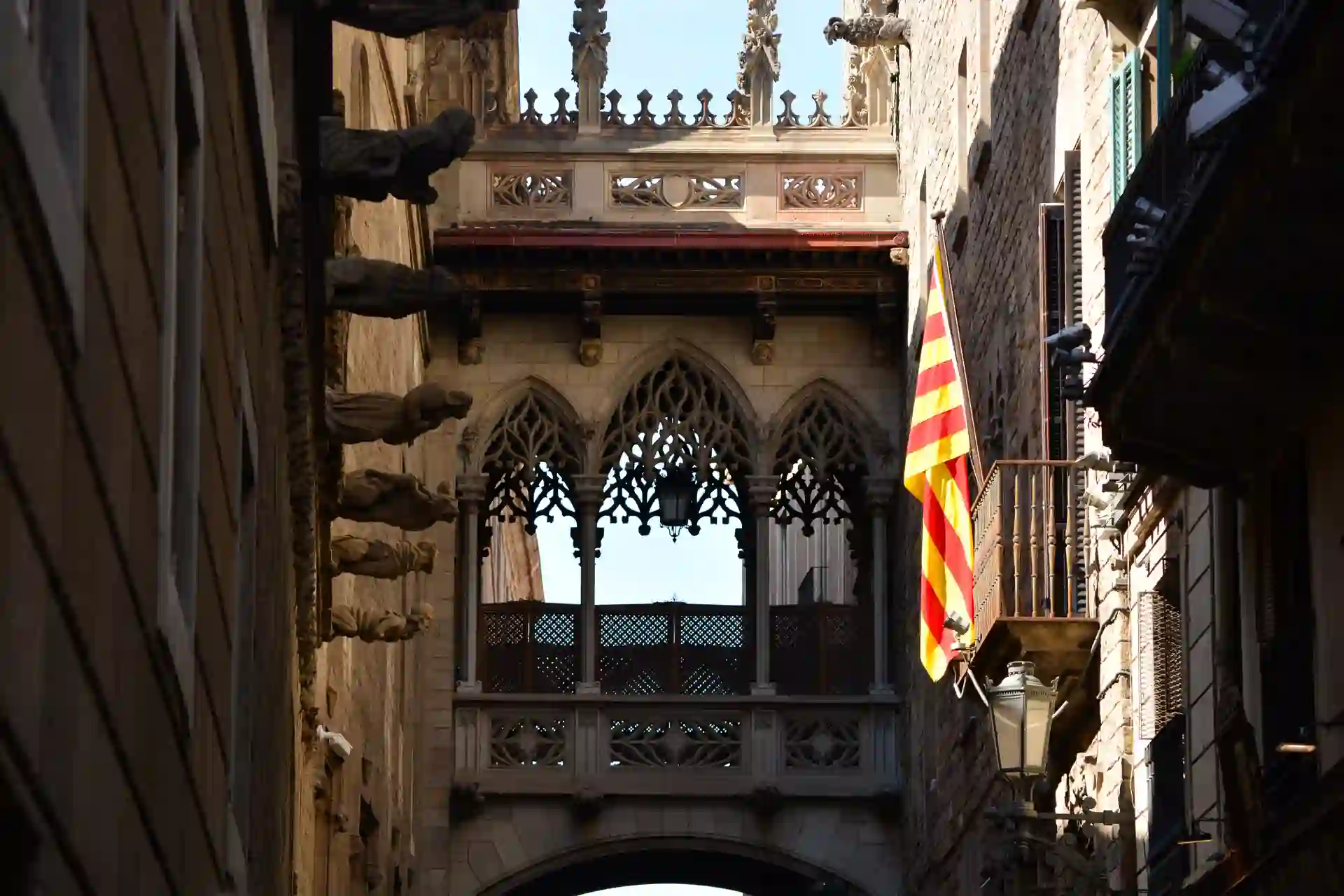
The Pont del Bisbe looks like 15th-century Gothic, but it dates from 1928: much of the Barri Gòtic was built for the 1929 Exposition.
A bridge born in 1928
The Pont del Bisbe is the most photographed image in the Barri Gòtic: pierced tracery, gargoyles, and, under the central arch, a stone skull that no one has ever fully explained. It looks like it's from the 15th century. It's from 1928. It was designed by Joan Rubió i Bellver, a disciple of Gaudí, in Flamboyant Gothic style, to create a private elevated walkway between the Palau de la Generalitat and the Casa dels Canonges, where Catalan presidents lived. When he unveiled the project, part of Barcelona already criticized it as fake: the whole city was getting ready for the 1929 International Exposition and needed a photogenic medieval quarter in time.
The architect who debunked it
Rubió i Bellver had no illusions about what he was building. He himself wrote, years later, that "in the Gothic Quarter there are no more than six houses that can, with any good will, be called Gothic." Those words came from the very man who had signed off on one of the district's most photographed buildings, and who knew, better than anyone, how much of that medieval air was new stone cut to look old.
A 1408 blueprint built in the 20th century
Barcelona Cathedral is genuinely Gothic, from the 14th century. Its main façade — the one facing Plaça Nova — is not: it was built between 1906 and 1913, financed by banker Manuel Girona, following a 1408 design by master builder Carlí that was never actually raised at the time for lack of money. In other words: Barcelona's most photographed "Gothic" façade isn't a copy of a real medieval building, it's the late construction of a medieval blueprint that had never been more than a blueprint. For five hundred years the Cathedral had a bare wall there; today it has spires, a rose window, and saints carved in freshly cut stone.
The house that changed address
Not everything is 1920s makeup: Casa Padellàs, on Plaça del Rei, is a genuine 16th-century palace. But it wasn't always there either. It was taken apart stone by stone from its original site, on Carrer dels Mercaders, and rebuilt in 1931 to save it from the opening of Via Laietana. Digging its new foundations turned up remains of Roman Barcino — the find you can now walk through underground at the Museu d'Història de Barcelona. Even the genuinely old buildings aren't where they were built.
A city made up for an Exposition
None of this was improvised. The Sociedad de Atracción de Forasteros, the body that had been promoting Barcelona since 1908, needed a presentable old quarter before 1929; the city council relocated Gothic doorways, windows and finials from other buildings around the city and commissioned new pieces to fill the gaps. Decades later, in 1958, Adolf Florensa, the municipal architect responsible for much of that work, admitted in writing that the name "Barrio Gótico" had been, above all, a tourist marketing device.
The real thing, hidden among the fake
The confusion isn't that the Barri Gòtic is fake from start to finish: it's that it mixes two thousand years of real layers with a 1920s varnish that makes them all look alike at first glance. Under that varnish lies a Roman gate from Augustus's Barcino, an old Jewish quarter dating from before 1391, and walls that still show the impact of 1938 bombs. Genuine Gothic architecture does exist in the district, but it's a minority; the real Roman and medieval remains sit, with no sign announcing it, alongside the façade that was built with 1929's visitors in mind.
None of this makes the Gòtic any less charming: it just spreads the mystery across more layers than it seems to have at first sight. The Secret of the Gothic Quarter covers ten stops through this same district, moving between Roman stone, Jewish stone, real Gothic and 1928 Gothic, and it never tells you upfront which is which — that's something you have to discover on foot.