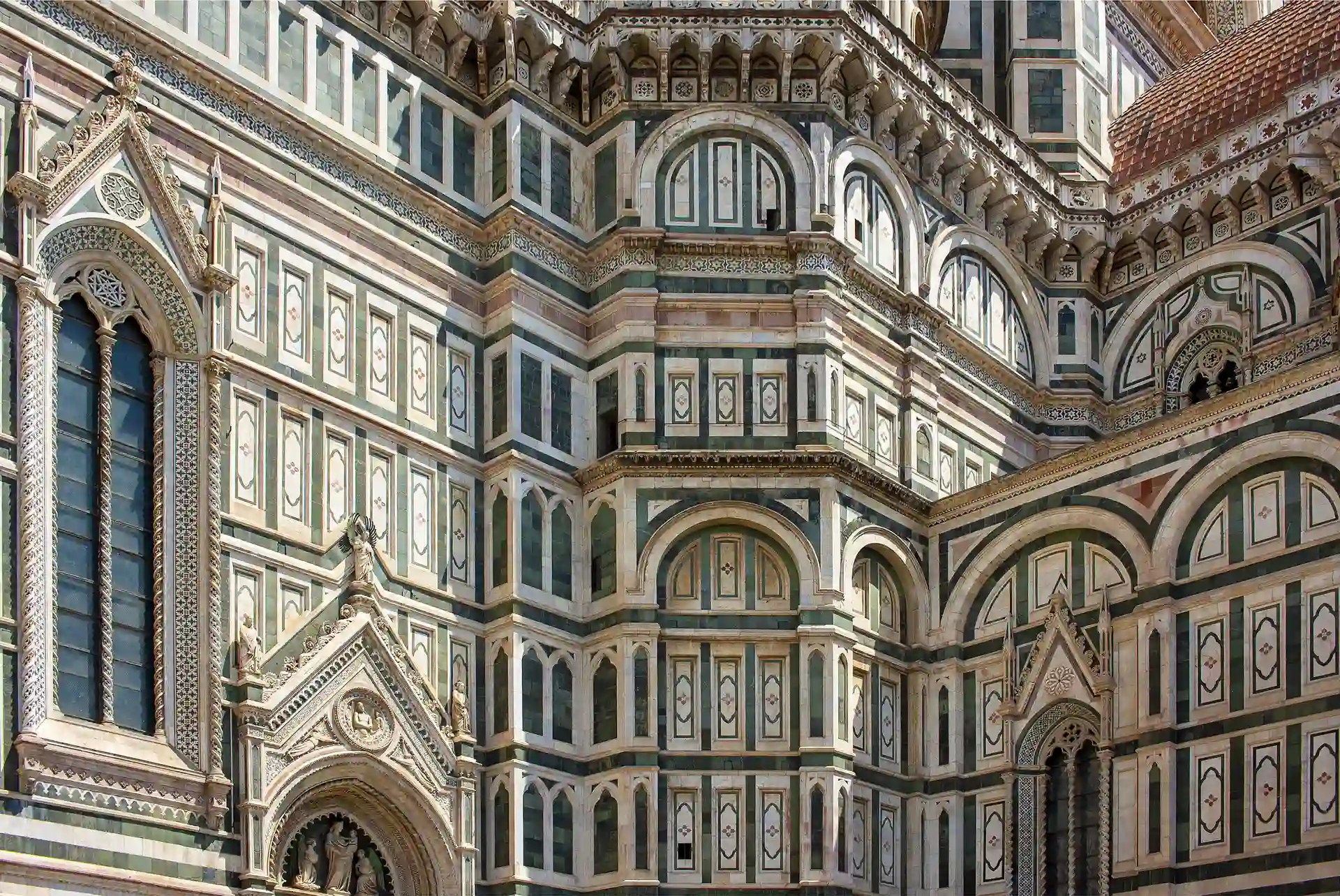
Florence
The Rivalry Florence Built in Stone, Dome by Dome
Brunelleschi hid his method for raising the Duomo's dome, and Florence's guilds fought that same battle one statue at a time at Orsanmichele.
The door Brunelleschi lost in 1401
Before the Duomo, Filippo Brunelleschi and Lorenzo Ghiberti had already gone head to head once. In 1401, Florence held a competition to design new bronze doors for the Baptistery, and Ghiberti won. The two trial reliefs — the same biblical scene, the sacrifice of Isaac, resolved in two different ways — are preserved today side by side at the Bargello Museum. Brunelleschi, defeated, left for Rome to study classical ruins for years. Seventeen years later his rematch would arrive, with a challenge far harder than a door: a dome nobody knew how to build.
The competition no one knew how to win
The Arte della Lana, the wool merchants' guild that funded the cathedral works, held a desperate competition in 1418: no one in Europe knew how to close the huge octagonal gap that had stood open for decades over the crossing of Santa Maria del Fiore. Brunelleschi submitted the only proposal that convinced the panel, and won — but the guild, wary of a man who refused to fully explain his plan, imposed a condition that must have stung: sharing the post, and the salary, with Ghiberti, his rival from 1401.
The model that didn't explain everything
Brunelleschi built a wood-and-brick model to guide the stonemasons on the job, with help from Donatello and Nanni di Banco — but he left it deliberately incomplete. He never wrote down the full system, nor explained it to Ghiberti, who was, in theory, his equal in the post. Over the years, as Ghiberti spent his time on other commissions around the city, Brunelleschi became, in practice, the sole authority over the works: the man who had the solution remained the only one who understood it in full.
The patent Brunelleschi requested out of fear
That same fear of being copied drove Brunelleschi to something unheard of for his time: in 1421 he requested, and obtained, from the Signoria of Florence the exclusive right, for three years, to use a barge of his own design to transport Carrara marble up the Arno. Legal historians consider this grant the first documented invention patent in the West — nearly four centuries before the word itself existed — and the fear behind it was the usual one: that a rival, Ghiberti chief among them, would copy his ingenuity without having risked a thing.
The egg that probably never broke that way
Giorgio Vasari, writing more than a century after the fact, tells how Brunelleschi challenged the other master builders to make an egg stand upright on a smooth surface: they all failed, and he tapped its base gently against the table to flatten it and stood it up, arguing that anyone could build the dome once they'd seen his plan, just as anyone could stand the egg up once they'd seen the trick. Antonio Manetti, who knew Brunelleschi personally and wrote the architect's first biography decades before Vasari, doesn't tell this anecdote at all, and several present-day historians regard it as literary dramatization rather than a documented fact. True or not, it sums up the man well: someone who preferred proving he had the solution to explaining it.
The fourteen niches of the same rivalry
The same logic of competing in public repeated itself just a few streets away, at Orsanmichele: the city required the major trade guilds to fill its fourteen exterior niches with a statue of each one's patron saint, and no guild wanted to be outdone by its neighbor. The richest — bankers, cloth merchants, wool traders — paid for bronze, up to ten times more expensive than marble, and hired Ghiberti; the smaller guilds settled for marble and turned to a still-young Donatello. Decades later, the Tribunale della Mercanzia — the merchants' court representing the big traders — commissioned Verrocchio for a bronze group to replace a Donatello statue already considered outdated. The butchers' niche, according to several art historians, even carries an unexpected signature: it's tentatively attributed to Brunelleschi himself.
None of this — the 1418 competition, the half-finished model, the patent born of fear, the egg that probably never happened — appears on a sign next to the dome or the niches. Florence's Rivals covers that same triangle between the Duomo, Piazza della Signoria and Ponte Vecchio, following the signs of rivalry that were actually carved into the stone, in plain sight of anyone who stops to look.