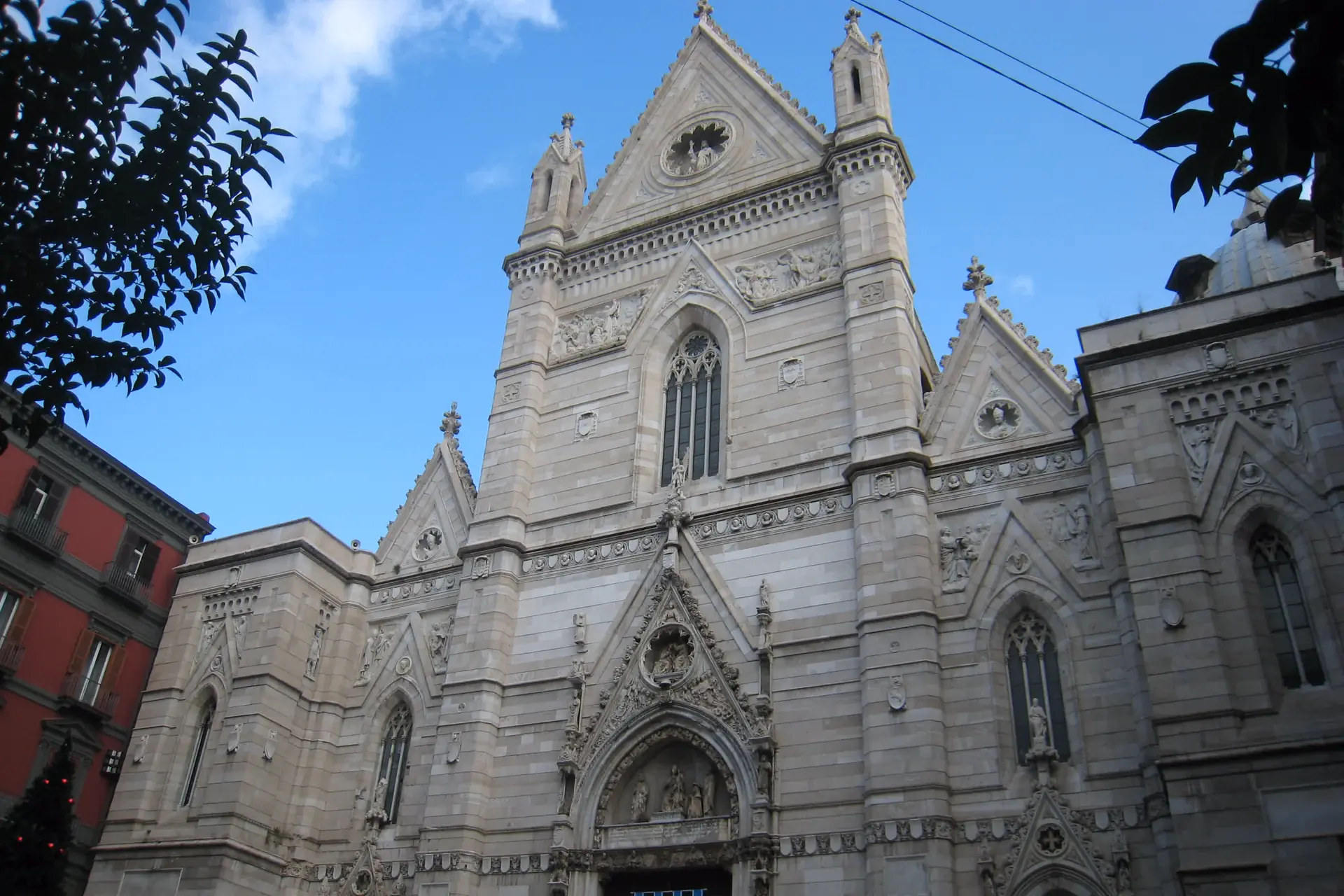
Naples
A 2,500-Year-Old Greek Street Still Splits Naples in Two
Before Naples there was Palaepolis, a neighboring Greek city: Spaccanapoli is its main avenue, and that's why it still splits the historic center in two.
The city that existed before Naples
In the late 8th century BC, colonists from Cumae — the oldest Greek colony on the Italian mainland — settled on the hill of Pizzofalcone, next to the small island where the Castel dell'Ovo now stands, and founded a settlement they called Parthenope, after the siren legend said had washed up on that same shore. Generations later, another group of Greek colonists founded a second city right next door, bigger and better planned: they called it Neapolis, 'new city.' To tell it apart from the first, the original settlement came to be known as Palaepolis (Παλαιόπολις), 'old city.' For decades the two coexisted a short distance apart, until Rome annexed the older one and only Neapolis kept growing.
Neapolis, the name that hasn't changed in 2,500 years
Neapolis didn't grow at random. Its founders laid out a regular grid of streets: three broad parallel avenues — the plateiai — crossed at right angles by twenty-one narrower streets, the stenopoi. That geometric planning, centuries ahead of the urban-planning rules later credited to Hippodamus of Miletus, still shapes the layout of the historic center today. And the name hasn't been lost either: 'Neápolis' passed into Latin as 'Neapolis,' from there into Italian as 'Napoli,' and into English as 'Naples' — with no change beyond the ordinary wear of about 2,500 years of unbroken use.
A Greek avenue that never stopped being a street
Of those three original plateiai, the southernmost is the one we know today as Spaccanapoli, pointing in a straight line toward the hill where Castel Sant'Elmo stands. The Romans folded it untouched into their own street plan, and the medieval and Baroque city simply built on top, façade by façade, without straightening out a single stretch. That's why, standing at one end, you can make out the other end without your eye hitting a single curve: this isn't a street designed to look straight, it's a street that has never stopped being the same line a group of Greek surveyors laid out 2,500 years ago.
When Rome conquered the city and changed almost nothing
In 326 BC, Rome ended the independence of Palaepolis-Neapolis after the war against the Samnites. But unlike other conquests, it didn't impose its language or customs: it made the city a 'civitas foederata,' an allied city with its own special status, and Naples kept speaking Greek and holding athletic and musical competitions in the Hellenic style for centuries, even under Roman rule. Emperor Nero himself chose Naples, not Rome, for his public debut as a singer, convinced — according to Roman chroniclers of the time — that an audience with Greek roots would appreciate his performance better than a Roman one would.
Three layers under the asphalt: quarry, aqueduct and shelter
The ground beneath Naples is as layered as its streets. The Greeks began digging into the volcanic tuff under Neapolis to quarry the blocks used to build walls and temples, leaving behind hundreds of empty galleries. The Romans expanded and connected them into the Bolla aqueduct, the network of cisterns and channels that supplied the city with drinking water until the 19th century. It stopped operating in 1884, when the Kingdom of Italy ordered it permanently shut down: a cholera outbreak the year before had shown that wastewater was seeping through the porous tuff and contaminating the water the city drank. For nearly sixty years those tunnels served as little more than an illegal dump, until 1942, in the middle of the Second World War, Italian authorities reclaimed them again: they dug access stairways and fitted them out as an air-raid shelter, up to 40 meters underground, for Neapolitans fleeing Allied bombing raids.
That whole stack of layers — Palaepolis under Neapolis, the Roman decumanus under the Baroque street, the Greek quarry under the aqueduct under the wartime shelter — can be walked on foot, in about two hours, on The Blade of Spaccanapoli: the most direct way to feel, street by street, why Naples has never stopped being 2,500 years old.