Toulouse
Why Toulouse Is Called the Pink City
Toulouse's pink brick wasn't an aesthetic choice: the Garonne valley has no stone quarries, and that pink only shows up at sunset.
A city with no stone
Toulouse was built in brick for a reason that has nothing to do with taste: there was no other option. The Garonne basin, where the city sits, has no limestone quarries; the nearest one is more than 70 km away, in the foothills of the Pyrenees, and getting stone here meant floating it down the Garonne or the Ariège on rafts, or, from the late 17th century on, along the Canal du Midi. The result: stone became a luxury, reserved for lintels, cornices and the odd detail, while the mud of the river itself, plentiful and free, became the material for everything else. The Romans were already working that alluvial clay in the 1st century BC to make fired brick in standardized sizes: Toulouse's recipe is two thousand years old.
A pink that depends on the hour
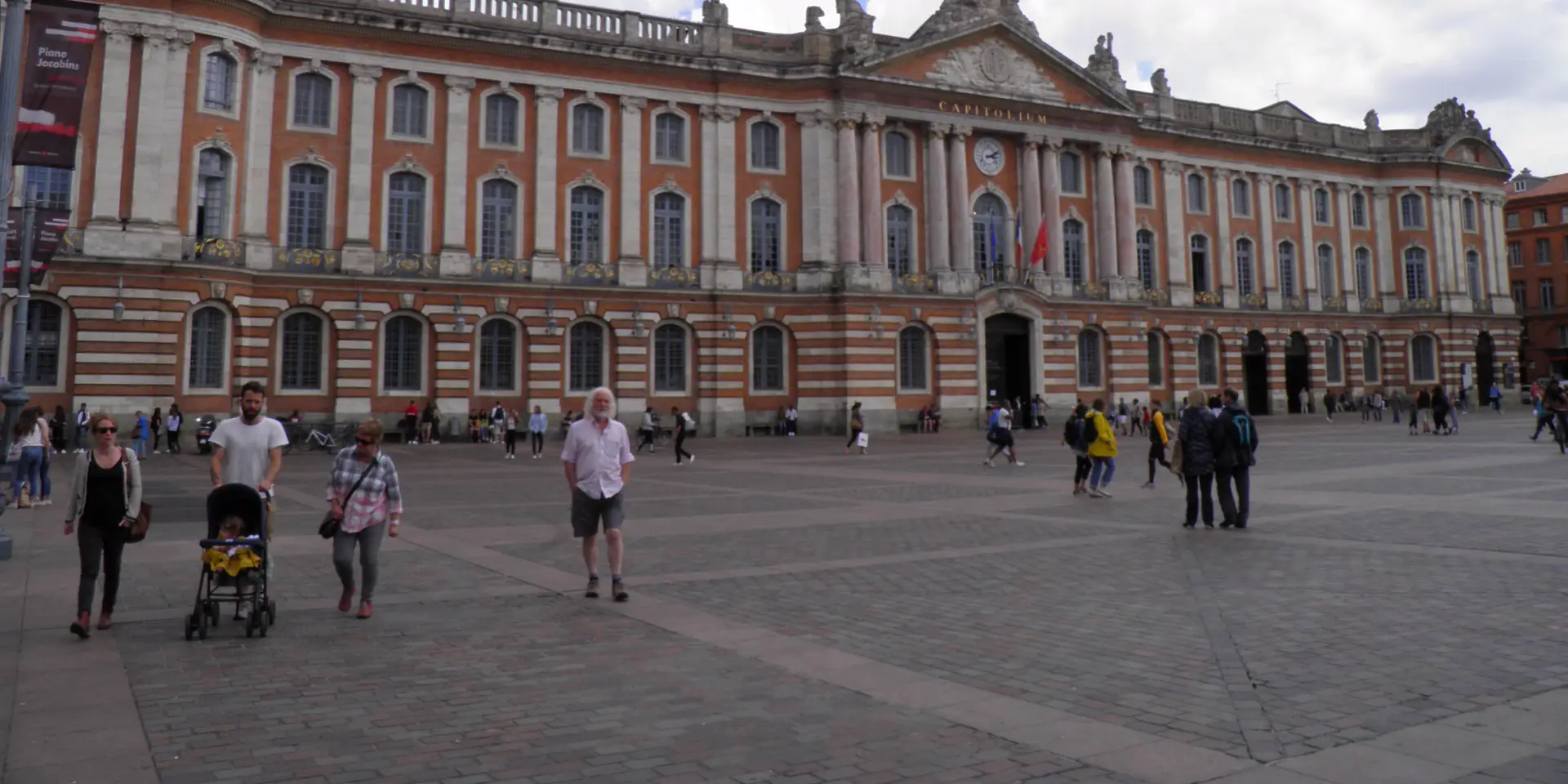
The nickname Ville Rose doesn't describe the color of the brick itself, but a very specific effect of light. At midday, that same brick looks mostly reddish, almost terracotta; the real pink, the intense one, only shows up at sunset, when the sun drops to a low angle in the west and strikes the façades at a slant: that's when they light up in a warm, golden pink, a phenomenon as much about climate as architecture. Not even all the bricks are alike: a gentler firing gives lighter tones, almost salmon, while a stronger firing darkens them toward reddish brown. The classic spot to see it is the Pont Neuf, looking toward the Quai de la Daurade, just as the sun starts to drop over the river.
A county almost as large as a kingdom
Before it was just another French city, Toulouse was the capital of a state with real weight of its own. In the early 13th century, under Count Raymond VI, the County of Toulouse wasn't limited to the city: it included the Rouergue, the Quercy, the Duchy of Narbonne and the marquisates of Gothia and Provence, a territory that rivaled in size the French king's own direct domain. The count paid formal homage to the crown, but governed, dispensed justice and waged war on his own account: the dependency was, above all, nominal.
The crusade that ended its independence
That autonomy ended over a matter of faith. The Toulouse region was the heartland of Catharism, a Christian heresy the Church of Rome wanted wiped out at any cost: in 1209 Pope Innocent III proclaimed a crusade, and for twenty years an army of nobles from northern France, first under the command of Simon de Montfort, tore through the Languedoc town by town. It wasn't just a religious war: it was also how the French crown ended up forcing the whole south of the country under its direct authority.
A wedding seals the annexation
The war was settled at a table, not on a battlefield. On 12 April 1229, in the Treaty of Meaux-Paris, Count Raymond VII made peace with the young King Louis IX and agreed to marry off Joan, his only daughter and heir, to Alphonse of Poitiers, the king's brother. The marriage produced no children, so when Alphonse died in 1271, the county reverted to the crown in full: forty-two years after that treaty, Toulouse stopped being the capital of anything but France.
All of this — the clay that stood in for stone, the pink that only appears in low light, the county that lost its power struggle with Paris — is still there, in the façades of the historic center. The Cross of the Pink City crosses that same area on foot, from the square that inherited the city's government to the largest Romanesque basilica in Europe, and lingers over the brick with the time a tourist plaque never gives it.