Paris
Why Sacré-Cœur Is a Monument to a Defeat, Not a Victory
Montmartre was the spark that set off the Paris Commune in 1871. Sacré-Cœur was built afterward, on the very same spot, as penance for the defeat.
The dawn of the cannons
When the Prussian siege of Paris ended, the National Guard had some 400 cannons scattered around the city, largely paid for by public subscription: money from ordinary Parisians, not the state. About 170 of those guns sat parked at the top of Montmartre, out of reach of Adolphe Thiers's new government, based in Versailles and wary of a capital that was still armed. Before dawn on 18 March 1871, two army brigades climbed the hill to seize them by surprise. The plan failed over a logistical detail: the soldiers showed up, but not the horses needed to drag the cannons back downhill. While they waited, the sun came up, and with it the women of Montmartre, on their way to buy milk and bread, who planted themselves between the troops and the artillery.
Two generals, one afternoon
Surrounded by the crowd, the troops ended up fraternizing with the National Guard instead of opening fire. General Claude Lecomte, who had in fact ordered his men to shoot at the crowd, was arrested by his own soldiers. Near Place Pigalle, they recognized another general, Clément-Thomas, out of uniform in civilian clothes — hated ever since he had put down an earlier workers' uprising with gunfire in 1848. Both men were taken to a house at number 6, rue des Rosiers, in Montmartre itself, and shot in the garden that same afternoon, without trial. The news reached Versailles before nightfall: Thiers's government evacuated Paris, and that flight is what started the Commune.
Seventy-two days and a week of blood
The Commune governed Paris independently from that 18 March until 28 May 1871: about ten weeks, almost always rounded off to "two months." It ended with the Semaine sanglante, the Bloody Week, when the Versailles army retook the city street by street. The exact death toll is still disputed a century and a half later: the classic counts put it as high as 20,000 people, combatants and those shot without trial combined; more recent reviews, drawing on fuller archives, bring it down to a range of 6,000 to 7,500. Whatever the true number, it was possibly the deadliest crackdown any street in Paris has ever seen.
A vow that predates the Commune itself
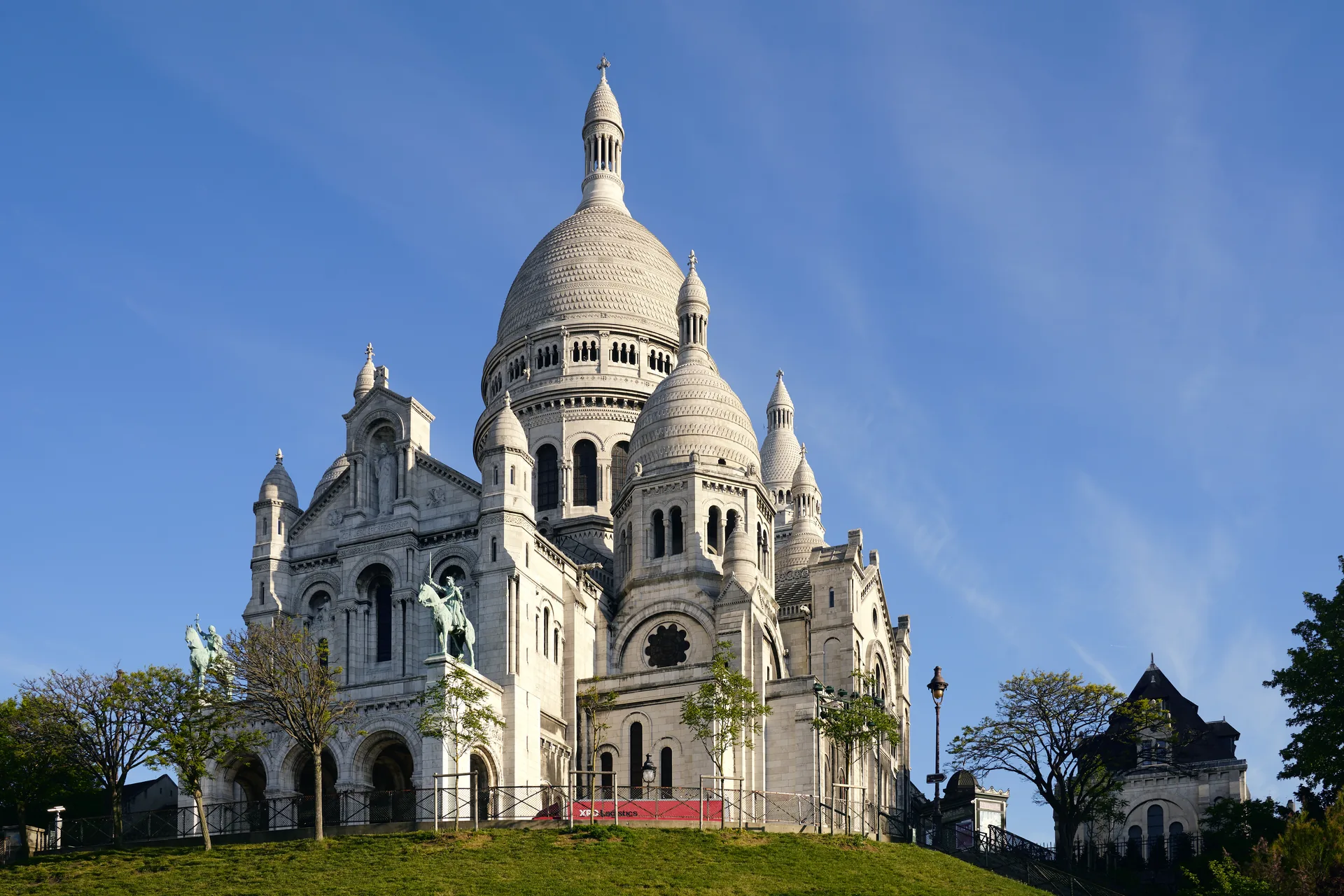
The idea of a basilica on Montmartre didn't come from the Commune: it was proposed in September 1870 by the Catholic Alexandre Legentil, in the middle of the Franco-Prussian War and before any uprising existed, as a religious vow in case France came through the invasion unscathed. But the Commune gave the project a new, very specific motive. In 1873, with France defeated and the Commune already crushed, the National Assembly, with its monarchist and Catholic majority, declared the basilica of "public utility" by law. The site chosen to build it was no geographic accident: it is, literally, the same hill where the uprising had begun and where Lecomte and Clément-Thomas had died.
The stone meant to bury the memory
The first stone was laid on 16 June 1875, blessed by Cardinal Guibert, Archbishop of Paris. That same day, it was stated plainly that the location was no accident: it was being built there because that was where the Commune had begun. The basilica would take more than four decades to be consecrated, in 1919, with a different world war just over, but from the very first day it functioned as what it was: a monument to Catholic, conservative penance, deliberately raised over the still-open wound of a workers' uprising crushed by gunfire. Today, millions of people climb up to it every year, with no idea that they are literally standing on the site of a summary execution.
The hill that tourists climb today, camera in hand, was hiding an armed uprising and two summary executions a century and a half ago. The White Hill of Montmartre covers the same Montmartre, following other signs the district has left behind — a village that stayed independent until 1860, a vineyard saved from property speculation, a garden that today carries the name of Louise Michel, the Communarde who fought here — eight stops for anyone who wants to keep pulling the thread.